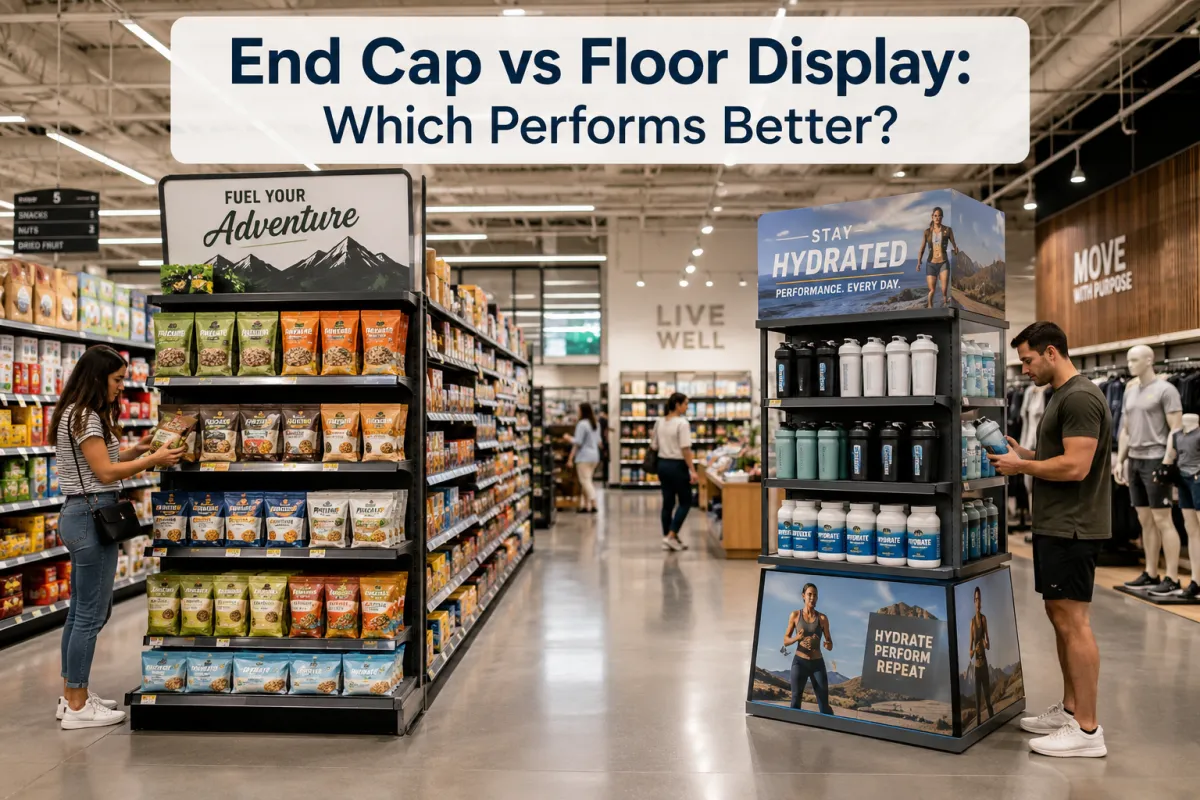
End Cap vs Floor Display: Which Performs Better?
What makes shoppers stop, look, and buy? In retail, the right display can make all the difference. While both end cap and floor displays are designed to attract attention and increase sales, each offers unique advantages depending on your store layout, product, and marketing goals. Understanding how they perform can help you create a stronger shopping experience and maximize your return on every display investment.
Walk through any supermarket, department store, pharmacy, or warehouse retailer, and you'll notice products strategically positioned to grab your attention. Some are placed at the end of aisles, while others stand independently throughout the sales floor. These aren't random merchandising decisions—they're carefully planned marketing tools designed to influence customer behavior.
But which option actually delivers better results? Is an end cap display the ultimate sales driver, or does a floor display offer greater flexibility and customer engagement?
In this guide, we'll compare both display types, explore where each performs best, and help you determine the ideal solution for your retail environment.
Understanding End Cap vs Floor Display: Which Performs Better?
Before comparing performance, it's important to understand what each display is designed to accomplish.
What Is an End Cap Display?
An end cap display is positioned at the end of a retail aisle. Because it naturally sits in a high-traffic location, it becomes one of the first merchandising features customers notice while navigating the store.
Retailers frequently use end caps to promote:
Seasonal products
Limited-time promotions
Best-selling merchandise
New product launches
Complementary products
Its biggest strength lies in visibility. Since customers pass aisle ends repeatedly during their shopping journey, end caps create multiple opportunities for products to be noticed.

What Is a Floor Display?
A floor display is a freestanding merchandising unit placed anywhere throughout the sales floor.
Unlike end caps, floor displays aren't restricted to aisle ends. They can appear near entrances, checkout lanes, promotional zones, waiting areas, or inside specific departments.
Common uses include:
Product demonstrations
Brand campaigns
New product introductions
Impulse-buy merchandise
Cross-promotional displays
Their flexibility allows retailers to create customized shopping experiences while guiding customer movement through the store.

End Cap vs Floor Display: Which Performs Better for Visibility?
Maximize Visibility with Strategic Placement
Visibility often determines whether a product gets noticed at all.
End caps naturally benefit from:
Heavy customer traffic
Easy sightlines
Consistent exposure
Familiar shopping patterns
Because shoppers frequently turn corners while moving through aisles, end caps receive repeated visual attention without requiring customers to alter their path.
Floor displays, however, offer strategic placement opportunities.
They can be positioned:
Near store entrances
Beside checkout counters
Along promotional pathways
Within high-demand departments
Around seasonal shopping areas
When placed thoughtfully, floor displays can outperform end caps by intercepting shoppers before they even begin browsing.
Ultimately, visibility depends less on display type and more on placement strategy.
Which Display Drives Better Sales?
Increase Impulse Purchases Through Positioning
Impulse buying remains one of retail's strongest revenue drivers.
End caps naturally encourage spontaneous purchases because they showcase products customers weren't necessarily planning to buy.
Examples include:
Snacks
Beverages
Holiday decorations
Travel-size products
Household essentials
Floor displays excel in impulse merchandising as well, especially near checkout lines or store entrances.
They're particularly effective for:
New product launches
Gift items
Promotional bundles
Limited editions
Brand collaborations
While end caps rely on traffic flow, floor displays create unexpected moments of discovery.
The better performer often depends on the shopping journey you've designed.

Compare Customer Engagement Across Displays
Compare Customer Engagement Across Displays
Customer engagement goes beyond visibility.
An effective display encourages shoppers to:
Stop
Browse
Touch products
Read signage
Compare options
Make purchasing decisions
Floor displays generally provide greater engagement opportunities because they often allow 360-degree access.
Customers can comfortably walk around them, examine products from multiple angles, and interact with merchandise more naturally.
End caps, meanwhile, excel at quick decision-making.
Since customers often encounter them while moving through the store, purchases tend to happen faster.
If your goal is education or storytelling, floor displays usually have the advantage.
If speed matters, end caps often win.
End Cap vs Floor Display: Which Performs Better for Product Presentation?
Enhance Product Presentation for Shoppers
Presentation strongly influences perceived value.
End caps typically feature:
Uniform shelving
Organized layouts
Promotional signage
Consistent branding
Their structured appearance helps products look clean and accessible.
Floor displays, however, allow significantly more creative freedom.
Retailers can incorporate:
Unique shapes
Interactive elements
Lighting
Digital screens
Brand storytelling
Lifestyle imagery
This flexibility creates memorable shopping experiences while helping products stand apart from competitors.
For premium products, floor displays often provide stronger visual impact.
Create Memorable In-Store Shopping Experiences
Modern shoppers expect more than shelves full of products.
They appreciate experiences.
Floor displays support immersive merchandising through:
Product demonstrations
Sampling stations
Interactive displays
QR code experiences
Educational messaging
These experiences increase time spent with products while strengthening brand recall.
End caps create memorable experiences differently.
Their strength lies in surprise.
Customers rounding an aisle corner often discover promotions they weren't expecting, creating excitement without interrupting shopping flow.
Both displays contribute to customer experience—but in different ways.

Improve Merchandising with Smarter Layouts
Retail success depends on thoughtful store design.
End caps integrate naturally into existing aisle layouts, making them easy to maintain and replenish.
Advantages include:
Organized inventory
Efficient restocking
Consistent product visibility
Better promotional planning
Floor displays require more planning.
Retailers must consider:
Customer traffic patterns
Safety regulations
Accessibility
Space availability
Shopping flow
When executed correctly, floor displays enhance navigation while highlighting priority products.
Optimize Retail Space for Efficiency
Every square foot matters.
End caps make efficient use of otherwise underutilized aisle ends.
They're ideal for stores with:
Limited floor space
Narrow aisles
High product density
Frequent promotions
Floor displays require dedicated floor space.
Although they consume more room, they create merchandising opportunities unavailable through shelving alone.
Retailers should evaluate:
Available space
Customer traffic
Product size
Store layout
Promotional calendar
Balancing these factors leads to smarter merchandising decisions.
Drive Stronger Sales Through Displays
Retail displays aren't simply decorative fixtures.
They're silent salespeople.
Whether using end caps or floor displays, success depends on:
Strong branding
Clear messaging
Attractive presentation
Strategic placement
Regular maintenance
Displays with empty shelves, outdated signage, or cluttered arrangements quickly lose effectiveness.
Keeping displays refreshed maintains customer interest while encouraging repeat purchases.
Capture Attention at Every Aisle
Retail environments are filled with distractions.
Successful displays break through visual clutter.
Effective displays often include:
Bold colors
Clean graphics
Simple messaging
Strong branding
Organized product layouts
Eye-catching shapes
Both end caps and floor displays can achieve these goals when designed thoughtfully.
The difference lies in how customers encounter them during their shopping journey.
Choosing Effective Retail Display Solutions
Selecting the right display isn't about choosing one over the other.
Instead, retailers should evaluate:
Product Type
Large products often suit floor displays.
Smaller packaged goods frequently perform well on end caps.
Store Layout
Compact stores may benefit more from end caps.
Open floor plans create greater flexibility for freestanding displays.
Marketing Objectives
Ask yourself:
Are you launching something new?
Promoting seasonal merchandise?
Encouraging impulse purchases?
Building brand awareness?
Educating shoppers?
Your objective should determine your display strategy.
Retail Displays That Boost Performance
Retailers who consistently achieve strong merchandising results rarely rely on one display type alone.
Instead, they combine both strategically.
For example:
End caps promote seasonal beverages.
Floor displays showcase complementary snacks.
End caps highlight promotions.
Floor displays demonstrate premium products.
End caps increase aisle traffic.
Floor displays create destination shopping.
Using multiple display formats allows retailers to reach customers at different stages of the buying journey.
Find Your Best Display Strategy
There's no universal answer because every retail environment is unique.
Consider these questions:
Where do customers naturally gather?
Which products generate impulse purchases?
Which items require explanation?
How often do promotions change?
What space is available?
Answering these questions helps identify the display strategy that aligns with your business goals.
Rather than asking only "End Cap vs Floor Display: Which Performs Better?", retailers should ask:
"Which display performs better for this specific product, campaign, and customer?"
That perspective often leads to better merchandising decisions.
Best Practices for Both Display Types
To maximize results regardless of display choice:
Keep displays fully stocked.
Use clear pricing.
Highlight promotional offers.
Maintain consistent branding.
Refresh displays regularly.
Use quality materials.
Position products at eye level whenever possible.
Measure display performance using sales data.
Rotate featured products seasonally.
Test different layouts to improve results.
Small improvements often lead to measurable sales increases.
Frequently Asked Questions
What is the biggest advantage of an end cap display?
End cap displays offer exceptional visibility because they're positioned at the end of store aisles where customer traffic is naturally high.
Are floor displays better for new product launches?
Yes. Floor displays provide greater creative flexibility and can include educational messaging, demonstrations, and interactive branding that helps introduce new products.
Which display increases impulse purchases?
Both can increase impulse buying. End caps encourage spontaneous purchases during aisle navigation, while floor displays generate impulse sales when strategically positioned near entrances or checkout areas.
Can retailers use both display types together?
Absolutely. Many successful retailers combine end caps and floor displays to maximize product visibility, improve customer engagement, and support different marketing campaigns throughout the store.
How often should retail displays be updated?
Displays should be refreshed regularly to reflect seasonal promotions, new inventory, marketing campaigns, and changing customer interests. Frequent updates also keep the shopping experience engaging.
Conclusion

When asking "End Cap vs Floor Display: Which Performs Better?", the answer isn't as straightforward as choosing one winner. Both display types offer distinct advantages that can significantly influence customer behavior, product visibility, and overall sales performance.
End cap displays excel at attracting attention in high-traffic aisle locations, making them ideal for promotions, seasonal merchandise, and impulse purchases. Floor displays, on the other hand, provide unmatched flexibility, stronger brand storytelling, and immersive shopping experiences that help customers connect with products on a deeper level.
The most successful retailers don't view these displays as competitors—they use them together as complementary merchandising tools. By aligning display selection with your store layout, product category, customer journey, and marketing objectives, you can create a retail environment that captures attention, encourages engagement, and drives stronger sales over time.
Ultimately, the best display strategy is the one that supports your business goals while delivering a seamless and memorable shopping experience for every customer.